
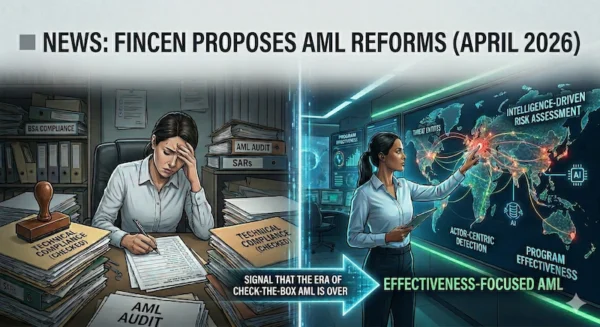
On April 7, 2026, FinCEN issued a Notice of Proposed Rulemaking that doesn’t tinker around the edges of BSA compliance — it proposes to fundamentally reform financial institutions’ AML/CFT programs, shifting the entire supervisory framework away from technical compliance and toward program effectiveness.
Read that again. Not whether you checked all the boxes. Whether your program actually works.
This is a meaningful shift, and if your institution is still thinking about AML in terms of filing volume and audit defensibility, the clock is running.
Secretary Bessent framed it plainly:
“For too long, Washington has asked financial institutions to measure success by the volume of paperwork rather than their ability to stop illicit finance threats.”
The proposed rule does three things that compliance officers need to understand right now.
First, it gives financial institutions flexibility and discretion in mitigating illicit finance risks so they can direct more resources toward higher-risk areas rather than lower-risk areas — explicitly shifting AML/CFT programs away from a purely check-the-box exercise.
Second, it introduces a two-prong framework that distinguishes between deficiencies stemming from program design (“establishment”) and failures in the program’s operation (“maintenance”) — intended to promote consistent supervisory expectations and prevent conflating criticisms of program design with criticisms of day-to-day implementation.
Third — and this one matters particularly — in determining whether to pursue an enforcement action, FinCEN’s Director would consider the extent to which a bank advances AML/CFT Priorities by providing highly useful information to law enforcement or national security officials, and whether the bank is employing innovative tools such as artificial intelligence that demonstrate the effectiveness of its AML/CFT program.
In other words: institutions that use intelligence-grade tools and produce actionable outputs will be treated more favorably than those that merely satisfy procedural requirements. That’s not a subtle distinction.
The rule is still proposed. Public comments must be received 60 days after publication in the Federal Register. Final implementation will take time.
But the direction is unmistakable, and institutions that wait for a final rule to rethink their programs will be starting the work too late.
If your AML/CFT program is still built around anomaly detection and alert volume — still generating false positives that bury your analysts — the question isn’t whether this rule will eventually require you to do better. It’s whether you have the intelligence infrastructure to actually do better when it does.
The proposed rule would require risk assessment processes to evaluate the money laundering risks of a financial institution’s business activities, including products, services, distribution channels, customers, and geographic locations, and to incorporate the AML/CFT Priorities. That’s not a checkbox. That’s a living, dynamic picture of your actual threat environment.
Section 2 has argued for years that the core failure of AML isn’t technology — it’s a conceptual one. You can’t detect a threat you haven’t defined. You can’t assess risk you haven’t mapped. You can’t produce highly useful information for law enforcement if your program is built to count filings rather than identify criminals.
Hybrid Threat Central™ was built for exactly this environment. A living platform of threat entity intelligence, criminal network maps, and behavioral profiles — powering dynamic risk assessments and actor-centric detection logic that produces the kind of outputs FinCEN is now saying they want to see.
If you want to understand what an effectiveness-focused AML program looks like in practice — and what your institution needs to get there — we'd like to show you.
The FinCEN NPRM is a signal, not a deadline. But the window to build an effectiveness-focused AML program before enforcement focus sharpens is finite — and so is this opportunity.
Section 2 is accepting applications for the Hybrid Threat Central™ founding cohort: a group of three to five forward-thinking financial institutions that will be the first to deploy HTC as their financial crime intelligence platform. Charter Institutions receive founding-member pricing, direct access to the Section 2 team, and a seat at the table as the platform scales toward 1,000+ mapped threat networks.
Charter Institutions are not pilot customers — they are co-architects of the most significant intelligence infrastructure the financial crime compliance industry has ever had.
This is not a vendor relationship. It is a partnership between practitioners who understand what is at stake and have chosen to help define what comes next.
If that's your institution, we'd like to hear from you.