
The era of the "compliance dragnet" is coming to an end. For years, financial institutions have relied on historically imprecise scenarios that prioritize quantity over quality, resulting in a flood of low-value alerts and a 90% false-positive rate.
In their latest guidance, “Part II: Transitioning to Innovation,” the Wolfsberg Group issued a definitive call to action: it is time to fundamentally redesign monitoring programs. At Section 2, we believe this transition isn't just about better technology—it’s about a superior methodology. Our Hybrid Threat Finance (HTF)™ framework was built to answer the exact challenges Wolfsberg has identified.
Traditional AML systems often focus on the "middle" of a crime—the placement and layering of funds. However, the Wolfsberg Group now urges institutions to re-establish "desired outcomes" based on their specific risk profiles. Section 2’s Threat Risk Assessment was developed specifically to meet this mandate. It helps financial institutions understand their risk profile by considering both the inherent risk of their products and the dynamic influence of the global threat landscape.
To meet the Wolfsberg standard for innovation, a Threat Risk Assessment must move beyond static checkboxes. Below is how the HTF™ methodology maps to Wolfsberg’s "Transitioning to Innovation" objectives:
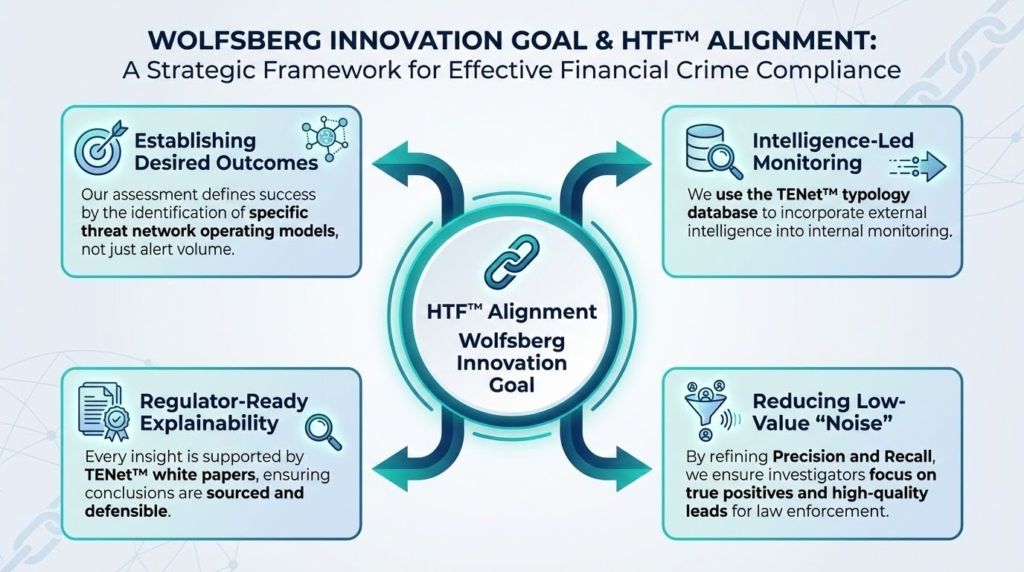
1. Precision and Recall: By using our TENet™ typology database, institutions can improve Precision (identifying true positives/false negatives) and Recall (ensuring no known threats are missed). This reduces the "noise" for investigators and provides law enforcement with higher-quality leads.
2. Expanded Risk Indicators: Innovation requires looking beyond just "dollars in, dollars out." HTF™ leverages diverse data points to identify the unique operating models of threat networks.
3. Explainability and Auditability: As Claudia Haberland, Head of Section 2’s Training + Tradecraft, notes: “The ability to explain how a model arrives at a conclusion is non-negotiable.” Our TENet™ white papers ensure that every insight generated is sourced, defensible, and regulator-ready.
Transitioning to innovation is no longer a choice—it is the new standard for protecting the global financial system.
The Wolfsberg Group has provided the roadmap; Section 2 provides the vehicle.